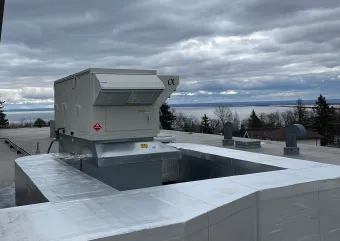
Value Proposition for Next Gen Rooftop Units
This guide introduces next gen rooftop units as packaged heating and cooling units that use efficient technology to heat and cool commercial spaces to reduce energy consumption and emissions.
Audience & intended use
Use this guide to support conversations between contractors and building owners throughout a rooftop unit replacement and proposal process.
Contractors: Use this to help guide proposal discussions, explain equipment options, and communicate the value of next gen RTUs. It can help address common questions related to installation considerations, building needs, and operating costs.
Building owners: Use this to understand your contractor’s proposal, the equipment and features being recommended, and other factors that might influence equipment selection. It can help you evaluate long term value, ask questions, and make confident decisions about your replacement.
What makes dual fuel heat pump RTUs a strong replacement option?
Dual fuel heat pump RTUs use air source heat pump technology as the primary heating source and automatically switch to a secondary fuel source, typically natural gas or propane, during extreme cold. This technology reduces energy consumption and emissions while maintaining comfort and reliability.
HOT TIP
Paired with an energy recovery ventilator, buildings can recover heat and energy normally lost to ventilation. Properly commissioned systems can deliver additional energy savings and improved indoor air quality, especially in buildings with high outdoor air requirements such as schools, healthcare facilities, restaurants, and manufacturing spaces.
Key advantages include:
- Saves energy when compared to standard gas furnace RTUs
- Resilient performance in cold climates
- Lower operating costs through efficient heating and cooling
- Straightforward installation with standard footprints
- Improved air quality with no energy penalty
Help your customers understand
Explore the differences between traditional and next gen RTU systems when selecting your next equipment.
| Customer Option | Traditional RTU | Dual fuel heat pump RTU | Dual fuel heat pump RTU paired with ERV |
|---|---|---|---|
| Key Consideration |
|
|
|
Why specify next gen RTUs?
Use these advantages to demonstrate how next gen RTUs deliver value beyond installation and throughout the life of the equipment.
| Traditional RTU | Dual fuel heat pump RTU | Dual fuel heat pump RTU with ERV | |
|---|---|---|---|
| Fits existing curb size | x | x | x |
| Fits existing wiring and transformer | x | x | x |
| Customer comfort year-round | x | x | x |
| Quieter operation | x | x | |
| Reduces energy use | x | X | |
| Reduced operations cost | x | X | |
| Meets rebate requirements | x | X | |
| Better indoor air quality | x |
Key reminders for your next proposal
- Utility support – Utilities in Minnesota offer financial rebates that reduce upfront costs and shorten payback periods for next gen RTUs.
- Lifecyle value – From planning to installation phases to operations, next gen RTUs deliver cost savings to both installers and occupants. Highlight lifecycle value over upfront costs to help customers make informed decisions.
- Energy benefits – Reduce operating costs, meet emission goals, and provide comfortable temperatures for building occupant.
To learn more, email info@nextgenrtu.org or visit www.nextgenrtus.org.
Next Gen Rooftop Units is a statewide program under Minnesota's Efficient Technology Accelerator (ETA), a partnership funded by the state’s participating investor-owned utilities (IOUs) and consumer-owned utilities (COUs), administered by the Minnesota Department of Commerce, Division of Energy Resources (DER), and implemented by Center for Energy and Environment (CEE).